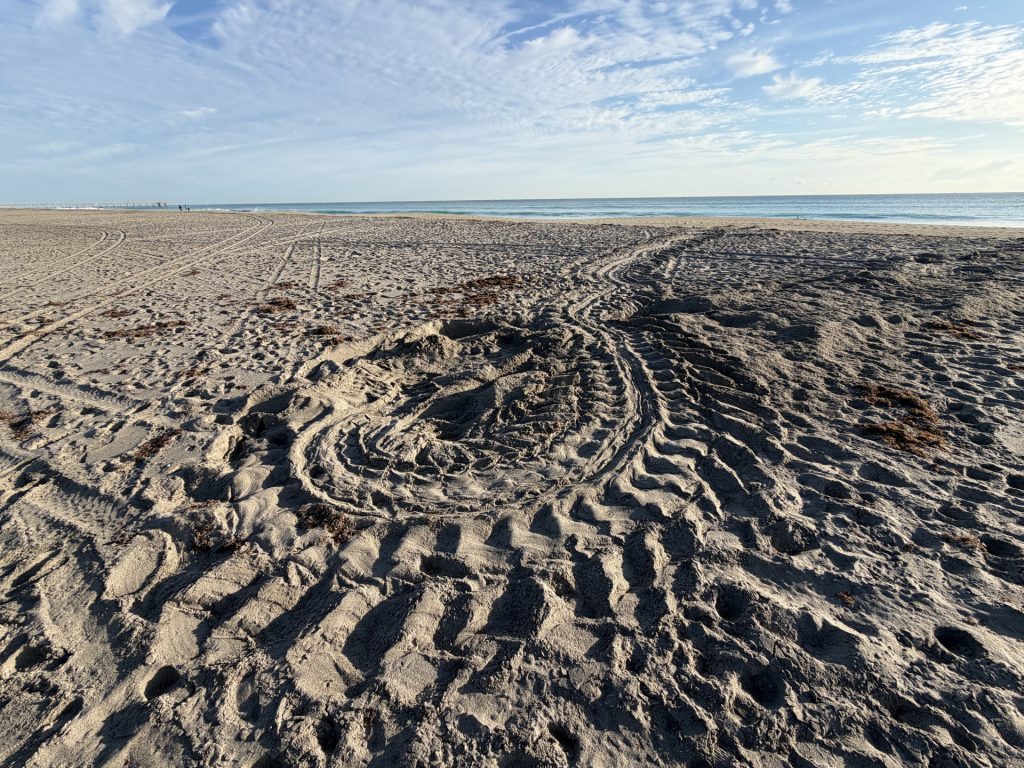
Juno Beach, Fla. (February 11, 2026) – On Wednesday, February 11, Loggerhead Marinelife Center (LMC) documented the earliest sea turtle nest ever recorded by the Center, signaling the start of what is expected to be another busy nesting season. The earliest nest on record in the state of Florida occurred on February 4, 2025. The season officially runs from March 1 through October 31, when tens of thousands of sea turtles return to Palm Beach County to lay their eggs. Nesting season serves as a reminder of the recently expanded voluntary Sea Turtle Protection Zone (STPZ), which now includes Palm Beach County’s entire 45-mile stretch of coastline.
“Likely due to rising ocean temperatures, we recorded the earliest sea turtle nest on record in the history of LMC’s monitoring efforts today,” said Justin Perrault, Vice President of Research at Loggerhead Marinelife Center. “This nesting season, we’re leading several research projects involving satellite tagging, nest temperatures, foraging and fasting behavior, toxicology, and dive information in relation to the STPZ.”
Last year, LMC partnered with Gumbo Limbo Nature Center to expand its voluntary STPZ zone given the higher risk turtles face from boat strikes. The STPZ recommends that boaters minimize traveling within the designated area, operate at the slowest, safest speed possible in the zone, wear polarized sunglasses, and keep eyes ahead during travel to help spot and protect sea turtles and other marine life. The zone extends 1 mile offshore.
To allow LMC’s research team to concentrate on the most densely nested areas of beaches, the Center will now focus monitoring on an 8.5-mile stretch of shoreline, compared to the 9.5-mile stretch monitored in previous seasons. The Florida Fish and Wildlife Conservation Commission (FWC) will monitor the remaining section of beach in northern Palm Beach County.
In 2025, researchers at LMC recorded a total of 20,871 sea turtle nests from leatherbacks, loggerheads, and green turtles. To ensure another productive nesting season, LMC urges beachgoers to familiarize themselves with what to do if they encounter a nest, hatchling, or sea turtle. Visitors can best protect sea turtles by following the guidelines below.
- Keep Your Distance: Never approach or touch a nesting sea turtle. Keep your distance, remain quiet, and keep all lights off (including flash photography and cellphones). Touching, prodding, or shining lights is illegal and may cause nesting turtles to not lay eggs or disturb them, which can affect how well the nests are covered and camouflaged.
- Let Hatchlings Emerge: If you see hatchlings on the beach, allow them to crawl to the ocean on their own. Removing or digging hatchlings out of a nest is illegal. Removing sand above the nest will make it more difficult for the hatchlings to emerge.
- Avoid Certain Areas: Enter the beach at designated access points and avoid walking on the dunes or beach vegetation to protect sea turtle nests, shorebird nests, and the dune plant ecosystem.
- Minimize Light: Keep lights off at home while not in use and close your blinds at night to avoid adding to overall sky glow.
- Take Your Belongings: Remove obstacles such as beach chairs, tables, water sport equipment, and umbrellas before dark. Properly throw away trash so that it doesn’t blow into the water or become an obstacle for a sea turtle.
- Digging and Holes: Only dig holes below high tide line in the hard-packed sand to avoid incubating sea turtle nests, and avoid using shovels. Fill all holes back in and knock over sandcastles so that nesting turtles and hatchlings are not impacted by these structures.
If sea turtle eggs become exposed, LMC advises beachgoers to leave the eggs and nest untouched. If a hatchling seems disoriented, LMC advises visitors to bring the hatchling to its 24-hour rescue cooler, which is located at the entrance of the Center. Threatened and endangered hatchlings should be transported with extreme care in a bucket with damp sand (but no water) to prevent accidental drowning.
For more information on STPZ and nesting season, visit marinelife.org/STPZ. To track satellite-tagged sea turtles, visit marinelife.org/research. The STPZ project was funded in part by the Archie Carr Center for Sea Turtle Research and the Sea Turtle Grants Program. The Sea Turtle Grants Program is funded from proceeds from the sale of the Florida Sea Turtle License Plate. Learn more at https://helpingseaturtles.org/.